- Details
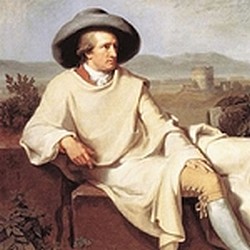
Last week I started to talk about Goethe's Wilhelm Meister's Apprenticeship and its songs. As I told you back then, this week I would explain some more things about Wilhelm's life before starting with the first song. If you are thinking of reading the novel, I would recommend to go direct to the song. If you continue reading, though, I hope you have enough time and energy. Are you ready?
- Details
 Imagine there was the Art Song Awards, a kind of Academy Awards (I wonder... how would it be known? The Schuberts? Would the statuette be a linden branch?). Anyway, if the awards existed, Johann Wolfgang Goethe would clearly be nominated to two categories: "The most musicalized poet" and "The most adapted poem ever". So far, I've published about ninety posts on the blog's Catalan version; twelve of the songs have already been Goethe's poems, the only poet that could put him in the shade would be Rückert, but just because I have weakness for him (to be honest, though, they are far from being comparable...)
- Details
 If I tell you that our week’s guest composed about five hundred songs, plus three symphonies, ten operas, ballets, incidental and chamber music, you might think of a Romantic composer. Nevertheless this composer wrote most of those works during the second half of the 20th century and his last opera was premiered in 2005. Today, then, we are talking about Ned Rorem, born in the USA on October 23, 1923 who is about to be 90 this year.
- Details

When someone dies at 35 it's always a tragedy for his family and his friends. If the person has a public presence and is as talented as Wunderlich was, we all wonder (probably with a bit of egoism) what he could have done if he would have had more time. I wonder if Wunderlich had reached perfection, as Giesen suggests. Where would his career have headed? It's difficult to say; his operatic career was impressive, he played many, many roles during the ten years it lasted, but he still had a long way to go in Lied.
- Details

Some weeks ago, a friend of mine asked me to listen to a recording he had just bought, with lieder by Strauss sung by Konrad Jarnot. Jarnot had been a delightful discovery for him but his enthusiasm about the recording was due to... the Vier letzte Lieder! A baritone singing the four last songs by Strauss! I must admit, I was as surprised as my friend.
Series